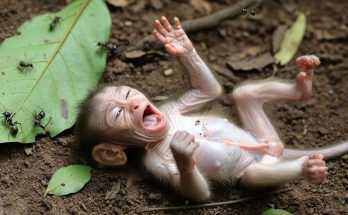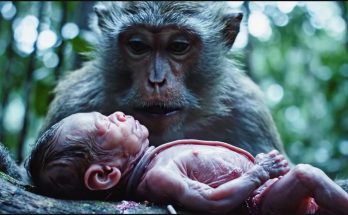

The baby monkey was far too small to understand why it was alone. It clung to a broken branch near the edge of the forest, crying softly, its tiny body weak and trembling. Its mother was gone, taken by the dangers of the wild, leaving behind a life that had barely begun.
Above the clearing, bright wings fluttered.
A large green parrot landed on a nearby branch, tilting its head as it listened. The sound was unfamiliar—thin, broken cries that didn’t belong to any bird it knew. Curious and cautious, the parrot hopped closer, its sharp eyes scanning the ground below.
There it saw the baby monkey.
So small. So helpless.
The parrot let out a low, gentle call, not sharp or warning, but soft and questioning. The baby monkey lifted its head weakly, eyes barely open. It cried again, reaching upward without knowing why.
Something ancient and instinctive stirred in the parrot’s heart.
Slowly, carefully, the parrot climbed down the tree, hopping from branch to branch until it was close enough to the ground. It kept its wings half-open, ready to flee if danger appeared. But the baby monkey did not move. It only cried.
The parrot leaned forward and touched the baby gently with its beak. The baby flinched at first, then went still. The touch was warm. Not like its mother—but not cold either.
The parrot stayed.
It positioned itself beside the baby, spreading one wing slightly to block the cool breeze. The baby monkey crawled instinctively toward the warmth, pressing its tiny body against the parrot’s feathers. The parrot froze, then slowly relaxed.
From that moment on, the forest watched something rare unfold.
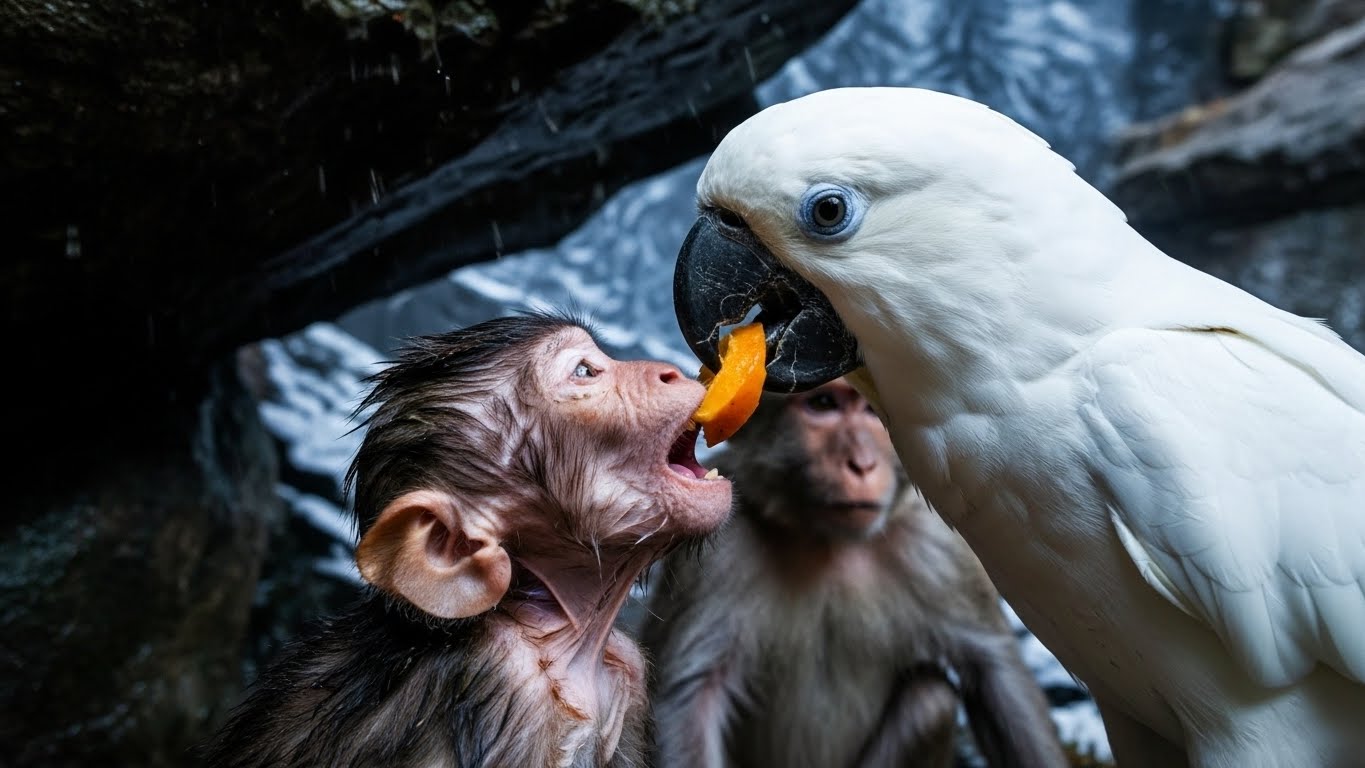
Each morning, the parrot searched for soft fruit, chewing it carefully and offering small pieces to the baby monkey. It brought drops of water in its beak, letting them fall gently onto the baby’s lips. The baby didn’t understand the kindness, but it felt it. It clung, slept, and slowly grew stronger.
At night, the parrot wrapped its wings around the baby monkey, holding it close against its chest. When the baby cried from hunger or fear, the parrot answered with quiet murmurs, rocking slightly on the branch they shared.
Other animals noticed.
A deer paused at the edge of the clearing, watching silently. A family of squirrels stopped their chatter, curious. Even the insects seemed gentler, as if sensing something sacred.
Days passed.
The baby monkey learned to grip branches, its fingers growing stronger. It learned to climb, wobbling at first, always staying close to the parrot. When it slipped, the parrot flapped its wings urgently, steadying it, calling softly.
They were an unlikely pair—feathers and fur, wings and hands—but they moved together like family.
One afternoon, a troop of monkeys passed through the trees. The parrot grew alert, wings spreading protectively as the baby monkey whimpered. A female monkey stopped, her eyes fixing on the little one. She moved closer, sniffing the air, calling gently.
The baby monkey lifted its head.
Something familiar stirred.
The parrot stepped back slowly, watching as the mother monkey reached out and gathered the baby into her arms. The baby clung instantly, burying its face into her chest.
The parrot did not cry out. It only watched.
Before disappearing into the trees, the mother monkey paused. She looked back at the parrot—just for a moment. Then she went on, carrying the baby safely away.
The clearing felt quiet again.
But it was not empty.
The parrot returned to its high branch, feathers ruffled by the breeze. It watched the forest with calm eyes, knowing it had done what it could.
In the wild, survival is often cruel and lonely. But sometimes, compassion crosses boundaries—between species, shapes, and instincts.
A parrot raised a baby monkey long enough for life to continue.
And the forest remembered that kindness.
Because even in the wildest places, love can come from the most unexpected wings.