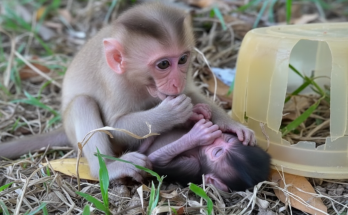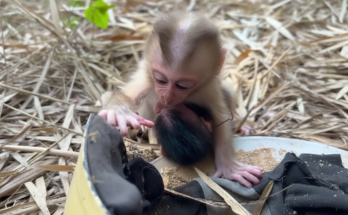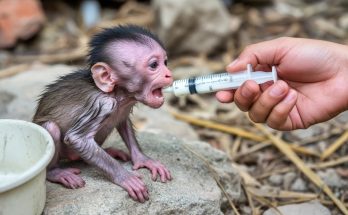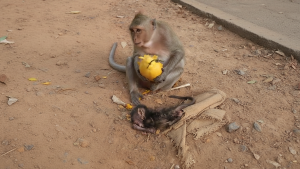
The scene is painful, confusing, and heartbreaking—but what happened is not as simple as it looks.
The mother monkey was eating while her baby lay nearby, weak and crying. To an outside eye, it looked like she did not care. It looked like she chose food over her baby. And when the baby died, it felt unbearable—as if the mother had abandoned it on purpose.
But the truth in the wild is more complicated, and far more tragic.
The mother was desperately hungry.
She had likely gone without enough food for a long time—especially after pregnancy and birth. Producing milk takes enormous energy. When a mother monkey becomes too weak, her body may stop producing milk entirely. In that state, if she does not eat, she may die too.
Her instincts were conflicted.
One instinct told her: feed the baby.
Another instinct screamed: eat now or you will not survive.
Sometimes, when survival pressure becomes extreme, nature forces impossible choices.
The baby was already very weak.
It had been hungry, cold, injured, and exhausted for too long. By the time the mother focused on eating, the baby’s body may already have been failing. Crying less. Moving less. Fighting less. These are signs a newborn is close to death.
The mother may not have understood what was happening.
Animals do not understand death the way humans do. She may have believed the baby would recover. She may have been overwhelmed, stressed, or physically unable to respond properly. Extreme hunger and stress can disrupt maternal behavior, even in loving mothers.
This does not mean she did not love her baby.
It means her body and mind were pushed beyond their limits.
As she ate, the baby grew quieter.
The cries faded. The small body stopped moving. Life slipped away silently. By the time the mother turned back, it was already too late.
The baby died not because the mother was cruel—but because nature is unforgiving.
This happens in the wild more often than we want to accept:
-
Mothers too weak to produce milk
-
Babies too fragile to survive delays
-
Hunger forcing survival choices
-
Care failing not from lack of love, but lack of strength
The mother did not “let” the baby die in a human sense.
She was trapped in a moment where saving one life meant risking both.
And when the baby died, the loss was real.
Many mothers show confusion, sadness, or distress afterward—touching the body, staying near it, grooming it, or sitting silently. These are signs that the bond existed, even if survival broke it.
This is why the moment feels so cruel.
Because it is not a story of evil.
It is a story of limits.
Of hunger overpowering instinct.
Of a baby who needed more than the world could give.
And that is what makes it truly heartbreaking.