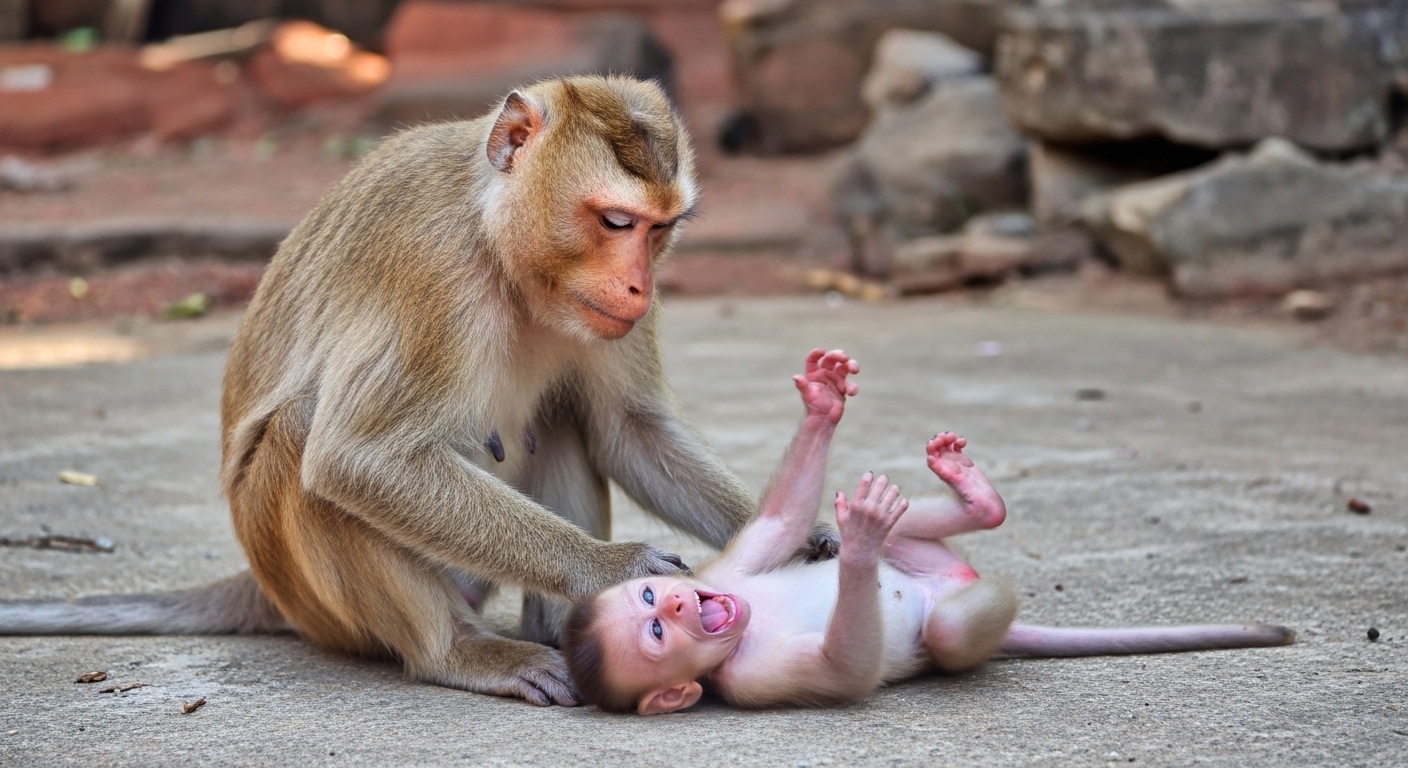
The baby monkey did not understand what was happening.
He only knew that he was hungry, tired, and afraid—and his mother was not caring for him the way he needed. He followed her with slow, unsteady steps, crying softly, hoping she would turn around, pick him up, and make everything feel safe again.
But she didn’t.
To the baby, it felt like rejection.
To the baby, it felt like he was unloved.
Yet the reason a mother monkey does not take care of her baby is often more complicated—and far more painful—than it looks.
Sometimes, the mother herself is exhausted.
Life in the wild is harsh. She must search for food, avoid danger, protect herself, and survive every single day. If she is weak, sick, injured, or starving, her body may not have enough strength to care for her baby. When a mother is overwhelmed by survival, even love can be pushed aside by instinct.
Sometimes, she is under extreme stress.
Loud noises, threats from predators, humans nearby, or fights within the group can cause intense fear and anxiety. A stressed mother may become aggressive, impatient, or distant. She may push her baby away—not because she hates it, but because her mind is overwhelmed by danger.
Sometimes, the baby is sick or very weak.
This is the hardest truth.
In the wild, a mother may sense that her baby is too weak to survive. Caring for a weak baby requires extra energy—energy she may not have. Instinct may force her to focus on herself or future offspring instead. To us, this looks cruel. To nature, it is survival.
Sometimes, the mother is young or inexperienced.
First-time mothers do not always know how to care properly. They may not understand their baby’s cries. They may become annoyed or confused. They may leave the baby accidentally or fail to respond with warmth. This does not mean there is no feeling—only that they do not yet know how to be a mother.
Sometimes, her milk supply is low.
If the mother cannot produce enough milk, feeding becomes painful and stressful. The baby cries more. The mother becomes frustrated. This cycle can cause her to avoid the baby, even though the baby needs her most.
And sometimes… it is simply instinct, not emotion.
Monkeys do feel bonds, but their actions are guided strongly by survival instincts. What looks like “not caring” to humans may be a decision driven by fear, exhaustion, or biology—not cruelty.
But what about the baby?
The baby feels everything.
He feels hunger like pain.
He feels loneliness like fear.
He feels rejection like heartbreak.
He does not know about survival rules or instincts. He only knows that the arms he needs are not holding him. That is why the moment feels so pitiful. That is why watching it hurts so deeply.
The baby cries because crying is all he has.
And when the mother does not respond, the sadness feels unbearable.
Yet sometimes, even when it looks like she does not care, the mother is watching from a distance. Sometimes she stays nearby, ready to return if the danger passes. Sometimes she comes back later, when she is calmer, when she has food, when she has strength again.
Not all care looks gentle.
Not all love looks warm.
Nature is not kind—but it is real.
So when we ask, “Why mom not take care baby?”
The answer is not simple.
It is hunger.
It is fear.
It is exhaustion.
It is instinct.
And in the middle of it all is a tiny baby—confused, scared, and deserving of love—making the moment one of the most heartbreaking sights in the wild. 💔🐒